
The Ultimate Smartphone Buying Guide (2026)
Most people choose smartphones based on specs—and regret it later. This guide breaks down everything that actually matters in 2026, from performance and cameras to software, battery life, and long-term value, helping you make a smarter buying decision.

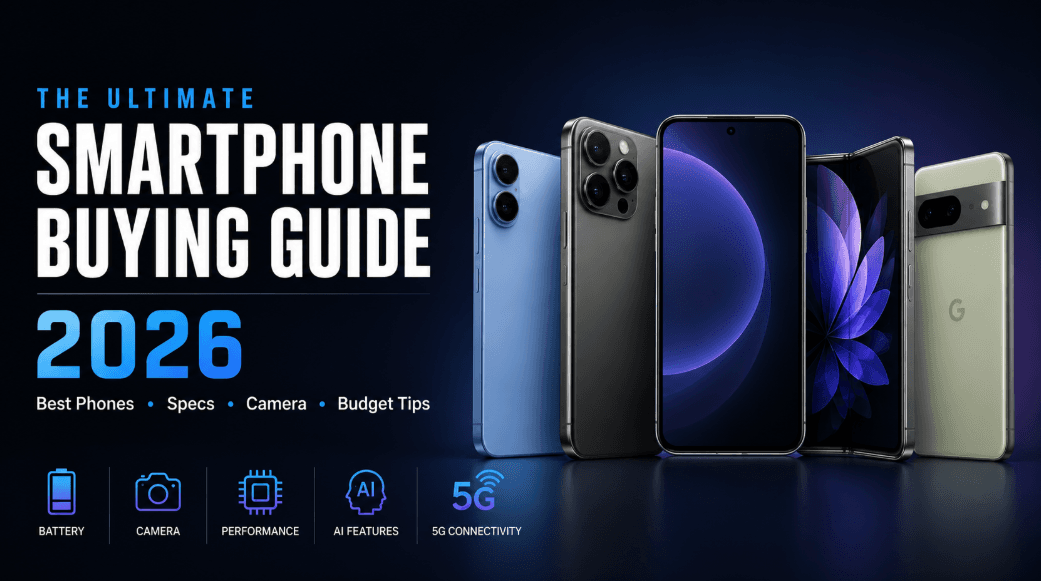
Buying a smartphone is more complicated than ever. Many people end up choosing the wrong device by focusing on marketing claims, megapixel counts, or raw specifications instead of real-world needs. A poor purchase can lead to slower performance, limited storage, weak battery life, shorter software support, and costly upgrades sooner than expected.
The reality is that specifications alone don't determine the overall smartphone experience. Factors such as software optimization, camera processing, battery efficiency, update policies, and ecosystem integration often matter just as much as the hardware itself. This guide provides a practical framework to help you choose the right smartphone based on your needs, budget, and long-term expectations.
Quick Smartphone Buying Checklist
Before purchasing a smartphone, consider:
Budget – How much are you willing to spend?
Usage – Gaming, photography, work, content creation, or everyday use.
Longevity – How many years do you plan to keep the device?
Software Support – Security updates and Android/iOS upgrades.
Camera Needs – Casual photos, social media, or professional content creation.
Storage Requirements – 128GB, 256GB, 512GB, or more.
Ecosystem – Android, iPhone, smartwatches, tablets, and accessories.
Security – Biometric authentication, privacy features, and software protection.
Form Factor – Compact phones, large-screen devices, or foldables.
Step 1: Understand Your Needs Before Looking at Phones
The 90% Usage Rule
Before comparing smartphones, ask yourself one question: What will you do with your phone 90% of the time? Most users primarily use their phones for social media, messaging, photography, gaming, video streaming, work, content creation, travel, or health tracking.
Choosing a phone based on your actual usage is far more important than chasing specifications. Most buyers start in the wrong place by comparing megapixels, RAM, or benchmark scores before identifying their real needs.
Smartphone Buyer Personas
User Type | What Matters Most |
Student | Battery life, durability, value for money |
Professional | Performance, security, ecosystem integration |
Gamer | Thermals, refresh rate, touch sampling rate |
Parent | Durability, camera quality, parental controls |
Senior Citizen | Simplicity, large display, loud speakers, accessibility |
Frequent Traveler | Battery life, eSIM support, band compatibility, satellite features |
Content Creator | Camera versatility, storage, processing power |
Photographer | Sensor size, RAW support, zoom capabilities |
Mobile Filmmaker | Video quality, stabilization, log video, audio capture |
Entrepreneur | Productivity apps, security, battery life, dual SIM |
Privacy-Conscious User | On-device AI, security updates, minimal bloatware |
Power User | High-end specs, software features, customization |
Health-Focused User | Health sensors, wearable integration, fitness tracking |
Step 2: Set the Right Budget
Budget Categories Explained
Budget Range (NPR) | Category |
Under Rs 20,000 | Entry-Level Phones |
Rs 20,000–35,000 | Budget Phones |
Rs 35,000–50,000 | Lower Midrange Phones |
Rs 50,000–70,000 | Midrange Phones |
Rs 70,000–90,000 | Upper Midrange Phones |
Rs 90,000–110,000 | Affordable Flagships |
Rs 110,000–150,000 | Premium Flagships |
Rs 150,000+ | Ultra-Premium Devices |
What You Gain as You Spend More
Rs 30K vs Rs 50K: Better processors, AMOLED displays, improved cameras.
Rs 50K vs Rs 70K: Faster chipsets, better build quality, stronger cameras.
Rs 70K vs Rs 100K: Flagship-level performance, premium displays, longer software support.
Rs 100K vs Rs 150K: Best cameras, top-tier processors, advanced AI features.
Rs 150K+: Mostly premium features, ecosystem benefits, and cutting-edge technology.
Diminishing Returns
For most users, the sweet spot in 2026 is around Rs 50,000–90,000, where you get excellent performance, cameras, battery life, and software support without paying flagship premiums.
Step 3: The Smartphone Features That Actually Matter
Smartphone Specs Ranked by Importance
Priority | Features |
Tier 1 (Most Important) | Software Support, Battery Life, Camera Quality, Reliability |
Tier 2 | Processor, Storage, Display |
Tier 3 | Charging Speed, Speakers, Build Materials, Biometrics |
Processor
What Does a Smartphone Processor Actually Do?
A smartphone processor is the brain of the device and consists of several components:
CPU (Central Processing Unit): Handles apps, multitasking, and everyday operations.
GPU (Graphics Processing Unit): Responsible for gaming, graphics rendering, and visual performance.
NPU (Neural Processing Unit): Accelerates AI features such as image enhancement, live translation, voice assistants, and on-device AI processing.
ISP (Image Signal Processor): Processes photos and videos, often having a bigger impact on camera quality than megapixel count alone.
Processor Brands Explained
Snapdragon (Qualcomm): Excellent balance of performance, efficiency, gaming, and modem technology.
MediaTek Dimensity: Strong value, competitive performance, and increasingly powerful flagship chips.
Apple Silicon: Industry-leading efficiency, AI performance, and long-term software support.
Google Tensor: Optimized for AI, computational photography, and Pixel-exclusive features.
Exynos (Samsung): Focuses on AI and Samsung ecosystem integration.
Processor Longevity Guide
Chipset Tier | Expected Lifespan |
Entry-Level | 2–3 Years |
Midrange | 3–4 Years |
Upper Midrange | 4–5 Years |
Flagship | 5–7 Years |
RAM
How Much RAM Do You Need?
RAM | Recommended For |
4GB | Avoid in 2026 except basic usage |
6GB | Light users, calling, browsing, social media |
8GB | Most users and the current sweet spot |
12GB | Gamers, creators, and power users |
16GB+ | Heavy multitasking, AI features, professional workloads |
RAM Future-Proofing
Ownership Period | Recommended RAM |
3 Years | 8GB |
5 Years | 12GB |
7 Years | 12GB–16GB+ |
More RAM is not always better. For most users, 8GB–12GB provides the best balance between performance and value. Also remember that virtual RAM is not a substitute for physical RAM.
Storage
Storage Types Explained
Storage Type | Recommendation |
eMMC | Avoid in 2026 |
UFS 2.x | Acceptable for budget phones |
UFS 3.x | Recommended for most users |
UFS 4.0 | Flagship-level performance |
NVMe | Premium devices and highest speeds |
How Much Storage Do You Need?
Storage | Best For |
64GB | Basic users only |
128GB | Most users |
256GB | Heavy app users, gamers, photographers |
512GB | Content creators and videographers |
1TB | Professional creators and power users |
Display
The display is one of the most important parts of a smartphone because it affects everything you see and do. OLED displays offer deeper blacks, better contrast, richer colors, and improved battery efficiency compared to LCD panels, making them the preferred choice for most buyers. Premium devices often feature LTPO technology, which dynamically adjusts refresh rates to improve battery life without sacrificing smoothness.
Refresh rate determines how smooth a phone feels during scrolling, gaming, and animations. 60Hz is adequate, 90Hz feels noticeably smoother, 120Hz is the current sweet spot, while 144Hz primarily benefits competitive gamers. Adaptive refresh rates are generally better than fixed refresh rates because they help conserve battery when higher refresh rates are unnecessary.
Brightness is equally important. Typical brightness affects indoor visibility, while peak brightness determines how well a display performs outdoors under direct sunlight. Display size should match your usage habits: under 6.1 inches suits users who prefer compact phones, 6.1–6.5 inches is the most balanced size, 6.5–6.8 inches is ideal for media consumption and gaming, while 6.8 inches and above targets power users.
Camera
One of the biggest smartphone myths is that more megapixels automatically mean better photos. In reality, factors such as sensor size, aperture, lens quality, OIS (Optical Image Stabilization), EIS (Electronic Image Stabilization), and the ISP (Image Signal Processor) have a far greater impact on image quality than megapixel counts alone.
Most modern smartphones use multiple cameras for different purposes. The main camera handles everyday photography, the ultrawide camera captures wider scenes, while telephoto and periscope lenses provide true optical zoom. Optical zoom remains significantly better than hybrid or digital zoom because it preserves image quality.
When evaluating a camera system, focus on factors such as dynamic range, HDR performance, skin tone accuracy, low-light photography, night mode quality, portrait processing, and motion capture performance. Video quality is equally important — look for strong stabilization, reliable 4K recording, good audio capture, and support for higher frame rates such as 60fps or 120fps slow motion.
Battery
Many buyers assume a larger battery automatically means longer battery life, but that's not always true. Battery endurance depends on several factors including chip efficiency, display technology, software optimization, network usage, and background app management.
Most smartphones today use Lithium-Ion batteries, while newer premium devices are increasingly adopting Silicon Carbon batteries, which offer higher energy density and allow larger battery capacities without increasing phone size. This technology is expected to become more common throughout 2026.
Battery health naturally declines over time due to charging cycles, heat exposure, and aging. Excessive heat remains the biggest contributor to battery degradation. Most smartphone batteries typically last 3–5 years before noticeable degradation occurs.
Gaming
A powerful processor alone does not guarantee a great gaming experience. Modern mobile gaming depends on a combination of CPU performance, GPU capability, cooling efficiency, display quality, RAM, and software optimization. In many cases, thermal management becomes the real performance bottleneck.
The biggest difference between gaming phones and standard smartphones is cooling. Premium devices often use large vapor chambers, while budget devices rely on simpler graphite sheets. Better cooling reduces thermal throttling during extended gaming sessions.
Gaming-focused features that significantly improve experience: Higher touch sampling rates such as 240Hz or 360Hz provide faster touch response. Some gaming phones also include physical shoulder triggers, advanced haptics, and dedicated gaming modes.
Audio Experience
Bluetooth Audio Codecs
Codec | Quality Level |
SBC | Basic standard codec |
AAC | Optimized for Apple devices |
aptX / aptX HD | Higher-quality Android audio |
LDAC | High-resolution audio support |
LC3 | New Bluetooth 5.2+ codec with improved efficiency |
Connectivity
While 5G has become mainstream, not all 5G networks are the same. Sub-6GHz 5G provides wider coverage and better battery efficiency, while mmWave 5G delivers significantly higher speeds but has limited range and availability. For most users in 2026, 5G is worth having, but not worth paying a large premium for on its own.
eSIM technology is becoming increasingly common, allowing users to activate mobile plans digitally without a physical SIM card. Wi-Fi 6 is now the sweet spot, Wi-Fi 6E offers additional spectrum for less congestion, and Wi-Fi 7 delivers the highest speeds and lowest latency for future networks.
Satellite connectivity is one of the newest smartphone innovations. Selected flagship devices now support Emergency SOS via Satellite and limited satellite messaging, allowing communication even when no cellular network is available.
Software Experience
Android vs iPhone
Category | Android | iPhone |
Customization | Excellent | Limited |
Ease of Use | Good | Excellent |
App Ecosystem | Excellent | Excellent |
Privacy | Strong | Stronger Focus |
Software Updates | Brand Dependent | Industry Leading |
AI Features | Wide Variety | Deep Ecosystem Integration |
Value for Money | Better Across Budgets | Strong Resale Value |
Software Update Policies
Brand | Typical OS Updates |
Apple | 5–7+ Years |
Samsung | Up to 7 Years |
Google Pixel | Up to 7 Years |
OnePlus | 4–5 Years |
Xiaomi | 3–5 Years |
Nothing | 3–5 Years |
Motorola | 2–4 Years |
Security and Privacy
Security should be considered before purchase, not after. Smartphones increasingly store banking information, personal documents, passwords, health data, and private communications.
Biometric security varies significantly between devices. Ultrasonic fingerprint sensors are generally faster and more secure than optical implementations. For facial recognition, 3D systems such as Face ID provide substantially stronger security than standard 2D camera-based face unlock systems.
Security Patch Frequency by Brand
Brand | Typical Security Support |
Apple | 5–7+ Years |
Samsung | Monthly / Long-Term |
Google Pixel | Monthly / Long-Term |
OnePlus | Monthly or Quarterly |
Xiaomi | Varies by Model |
Nothing | Regular Long-Term Updates |
Motorola | Less Frequent on Budget Models |
AI Features and Future-Proofing
Artificial intelligence is becoming one of the biggest differentiators in smartphones. Modern devices now use AI for photography, search, productivity, communication, and system optimization.
The biggest distinction is between On-Device AI and Cloud AI. On-device AI processes data directly on the smartphone, offering better privacy, faster responses, and offline functionality. Cloud AI relies on remote servers and often requires internet access.
The 7 Pillars of Future-Proofing
1. Processor Tier
2. RAM Capacity
3. Storage Capacity
4. Software Update Commitment
5. Battery Replaceability
6. AI Capability (NPU)
7. Repairability
Foldable Phones
Foldable smartphones use flexible OLED displays and specialized hinge mechanisms to transform between compact and larger screen sizes. The two main categories are book-style foldables, such as the Galaxy Z Fold series, and flip-style foldables, such as the Galaxy Z Flip and Motorola Razr.
However, foldables still come with compromises: thicker bodies, higher weight, visible display creases, more complex repairs, and premium pricing. Foldables make sense for power users, multitaskers, business professionals, and early adopters.
Ownership Costs
Typical Resale Value After 2 Years
Brand | Approximate Resale Value |
iPhone | 60–75% |
Samsung | 45–60% |
Google Pixel | 40–55% |
OnePlus | 35–50% |
Xiaomi / Others | 25–45% |
New vs Refurbished vs Used Phones
Refurbished Grading
Grade | Condition |
Grade A | Excellent, minimal wear |
Grade B | Light cosmetic wear |
Grade C | Noticeable cosmetic damage |
Brand Guide
Brand | Best For |
Apple | Ecosystem, longevity, resale value |
Samsung | All-round flagship experience |
Google Pixel | Photography and AI features |
OnePlus | Performance and clean software |
Xiaomi / Redmi | Value for money |
OPPO / Realme | Fast charging and mainstream users |
Nothing | Clean software and design |
Motorola | Near-stock Android experience |
Sony | Enthusiasts and creators |
Honor / Huawei | Hardware innovation |
ASUS | Mobile gaming |
The Biggest Smartphone Buying Mistakes
Many smartphone purchases go wrong because buyers focus on marketing rather than real-world needs. Common mistakes include:
Buying based solely on brand loyalty
Choosing a phone based only on megapixels
Focusing only on RAM numbers
Trusting benchmark scores alone
Falling for 'Pro', 'Ultra', or 'Max' branding
Ignoring software update commitments
Buying insufficient storage
Overlooking repairability
Ignoring ergonomics and weight
Forgetting network band compatibility
Purchasing immediately at launch without reviews
Assuming the most expensive phone is automatically the best choice
Falling for artificial 'limited-time' promotions
Smartphone Buying Recommendations by User Type
User Type | What to Prioritize |
Students | Battery life, durability, value for money, long software support |
Parents | Reliable camera, durability, parental controls, battery life |
Professionals | Performance, security, ecosystem integration, multitasking |
Travelers | Battery life, eSIM support, network compatibility, compact design |
Gamers | Powerful processor, strong cooling, 120Hz+ display, large battery |
Content Creators | Versatile cameras, large storage, strong processor, good video features |
Mobile Photography | Large sensor, OIS, telephoto camera, RAW support |
Seniors | Large display, loud speakers, simple software, accessibility features |
Privacy-Focused Users | Strong security, regular updates, on-device AI, privacy controls |
Health-Focused Users | Wearable integration, health tracking, battery life |
Best Value Overall | Midrange or upper-midrange phones with long software support and balanced specifications |
Buying in Nepal: Authorized Retailers vs Grey Market
When buying a smartphone in Nepal, it's important to understand the difference between an authorized retailer and a grey market seller. Authorized distributors officially import smartphones into Nepal and provide warranty coverage, service support, and pricing policies.
Risks of Buying Grey Market Smartphones
Product authenticity may be difficult to verify.
Internal components may have been repaired, replaced, or refurbished without disclosure.
Official manufacturer warranty may not be valid in Nepal.
Warranty claims are often handled by the seller's own repair shop rather than an authorized service center.
Access to genuine replacement parts may be limited.
VAT bills and proper purchase documentation may not be available.
Always Ask for a VAT Bill
One of the most common mistakes smartphone buyers make in Nepal is purchasing devices without a VAT bill to save a small amount of money upfront. Without a valid VAT bill, warranty claims may become difficult or impossible, and after-sales service may be denied.
A smartphone is a long-term investment, and the small savings from avoiding a VAT bill are rarely worth the potential loss of warranty protection and service support. Always request a VAT bill, verify the warranty card, and confirm that the device is officially distributed in Nepal before making a purchase.
Final Verdict
The best smartphone is not necessarily the one with the fastest processor, the highest megapixel count, or the most expensive price tag. The right smartphone is the one that fits your lifestyle, matches your budget, receives reliable software and security updates, and delivers the features you actually use every day.
Before Buying, Ask Yourself:
What will I use this phone for most often?
How long do I plan to keep it?
Do I prioritize camera quality, gaming, battery life, or productivity?
How much storage and RAM do I realistically need?
How important are software updates and security?
Am I paying for features I'll actually use?
The goal isn't to buy the most expensive phone — it's to buy the right phone.
Latest News
Mobile Buying Guides

Best Tech Deals
Stay Updated
Get the latest tech news, reviews and guides straight to your inbox.
Latest Articles

Nepal Edition: How to Choose the Right Earbuds for Your Lifestyle and Budget

Buying a Laptop in Nepal (2026): The Only Guide You'll Ever Need
The Ultimate Tablet Buying Guide in Nepal (2026)